Students are allowed to use the entire course material and all exercise notes. The examination is organized as an online examination. The Inverted Classroom Teaching Method was applied in the winter term 2023 for the first time.
Total numbers in tables and presence maps shown below might slightly differ and appear inconsistent because of "unknown" students, i.e. students not visiting courses but attending examinations (or vice versa).
1. Digital Engineering - Summary
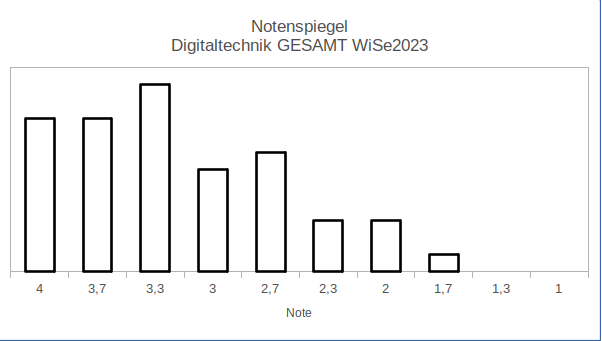
The minimum rate of points to pass the examination is 45%, i.e. 27 out of 60 points.
Grades greater than 4 do not pass the examination.
| Distribution Of Points |
 |
| Digital Engineering (all courses) - Overview Of Grades (1 - Best Grade, 4 - Minimimum Grade to Pass) |
 |
| Digital Engineering (all courses) - Simulated Pass Rate |
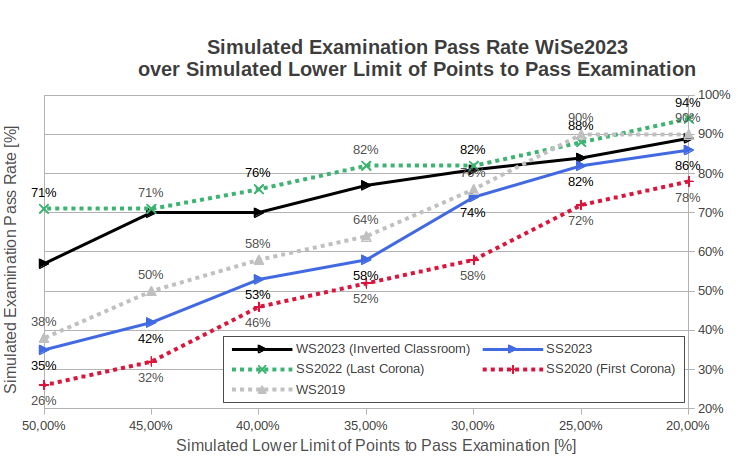 |
The simulation of the examination pass rate is performed by variations of the minimum rate to pass. The curves are a footprint of the collective knowledge of a course. This makes examination results and the collective students knowledge comparable over semesters. The course content is always the same while the Inverted Classroom teaching method was applied the first time during winter term 2023.
Example (green line): if 50% is the minimum rate of points to pass, 71% would have passed in the summer term 2022 (last corona semester).
Comparison (black line): with the same rate of points to pass, only 35% would have passed in the summer term 2023.
| Digital Engineering |
Enrolled |
Examined |
Attn Rate |
Passed |
Pass Rate |
| 1st attempt |
71 |
56 |
78% |
39 |
69% |
| 2nd attempt |
15 |
10 |
66% |
7 |
70% |
| 3rd attempt |
5 |
4 |
80% |
3 |
75% |
| Total |
91 |
70 |
77% |
49 |
70% |
1.1 Digital Engineering - Bachelor Electrical Engineering (EIB))
| Bachelor Electrical Engineering (EIB) |
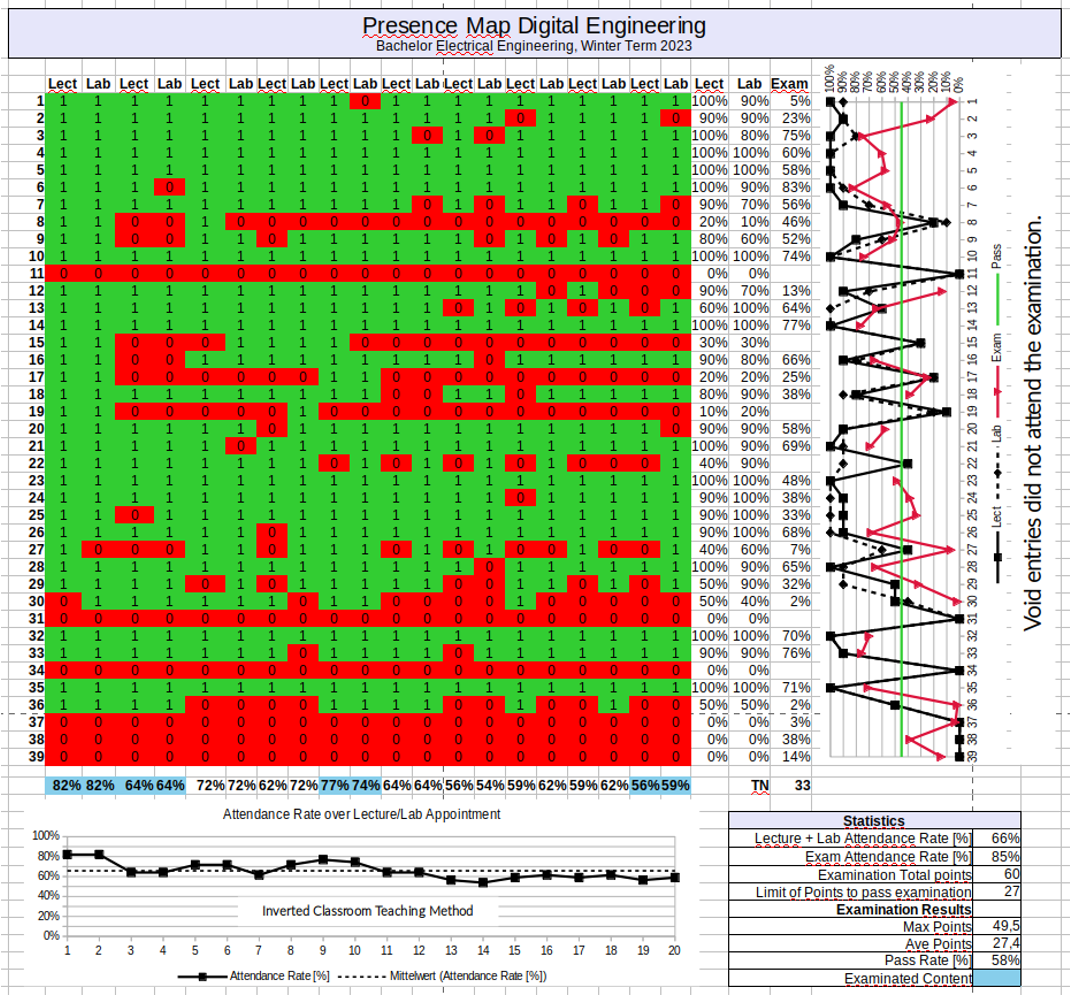 |
| Presence map with attendance and examination statistics. |
| Exam EIB (1st Semester) |
Enrolled |
Examined |
Attn Rate |
Passed |
Pass Rate |
| 1st attempt |
40 |
30 |
75% |
19 |
63% |
| 2nd attempt |
3 |
2 |
66% |
0 |
0% |
| 3rd attempt |
2 |
1 |
50% |
0 |
0% |
| Total |
45 |
33 |
73% |
19 |
58% |
| Exam EIB (1st Semester) |
Enrolled |
Examined |
Attn Rate |
Passed |
Pass Rate |
| Assessment |
16 |
10 |
62% |
6 |
60% |
1.2 Digital Engineering - Bachelor Intelligent Mobility Systems (IMS)
The course was not offered in the winter term for this branch of study. All candidates prepared themselves in self-study with the available online material, i.e. lecture videos, PDF exercise notes, former examinations with sample solutions.
| Exam IMS (2nd Semester) |
Enrolled |
Examined |
Attn Rate |
Passed |
Pass Rate |
| 1st attempt |
4 |
4 |
100% |
3 |
75% |
| 2nd attempt |
6 |
5 |
83% |
4 |
80% |
| 3rd attempt |
N/A |
N/A |
N/A |
N/A |
N/A |
| Total |
10 |
9 |
90% |
7 |
70% |
1.3 Digital Engineering - Bachelor Industrial Engineering (EIW) and Bachelor Industrial Engineering International (IWI)
| Bachelor Industrial Engineering (EIW) and Industrial Engineering International (IWI) |
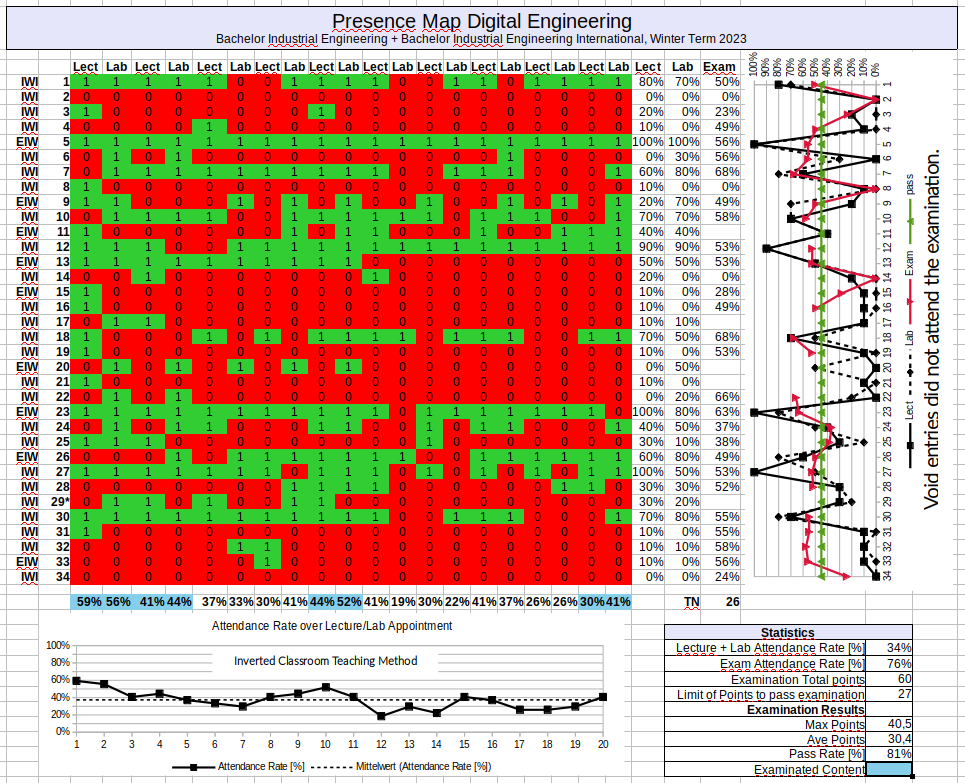 |
| Presence map with attendance and examination statistics. |
| Exam EIW (2nd Semester) |
Enrolled |
Examined |
Attn Rate |
Passed |
Pass Rate |
| 1st attempt |
7 |
5 |
71% |
4 |
80% |
| 2nd attempt |
4 |
2 |
50% |
2 |
100% |
| 3rd attempt |
1 |
1 |
100% |
1 |
100% |
| Total |
12 |
8 |
66% |
7 |
88% |
| Exam IWI (2nd Semester) |
Enrolled |
Examined |
Attn Rate |
Passed |
Pass Rate |
| 1st attempt |
20 |
17 |
85% |
13 |
77% |
| 2nd attempt |
2 |
1 |
50% |
1 |
100% |
| 3rd attempt |
1 |
1 |
100% |
1 |
100% |
| Total |
23 |
19 |
83% |
15 |
79% |
1.4 Digital Engineering - Bachelor Automobile Intelligent Systems
One candidate attended and passed the examination.
2. Electrical Engineering
Minimum rate of points to pass the examination is 50%, i.e. 22.5 out of 45 points. The Inverted Classroom Teaching Method was applied.
2.1. Electrical Engineering - Summary for EIW and IWI branches of study
| Electrical Engineering |
Enrolled |
Examined |
Attn Rate |
Passed |
Pass Rate |
| 1st attempt |
56 |
40 |
71% |
29 |
73% |
| 2nd attempt |
2 |
1 |
50% |
1 |
100% |
| 3rd attempt (or higher*) |
7 |
1 |
14% |
1 |
100% |
| Total |
65 |
42 |
65% |
31 |
74% |
*examination attempts for attestations without gradings are UNLIMITED as per examination regulations of the faculty Electrical Engineering
2.2 Electrical Engineering - Bachelor Industrial Engineering (EIW))
| Bachelor Industrial Engineering (EIW) |
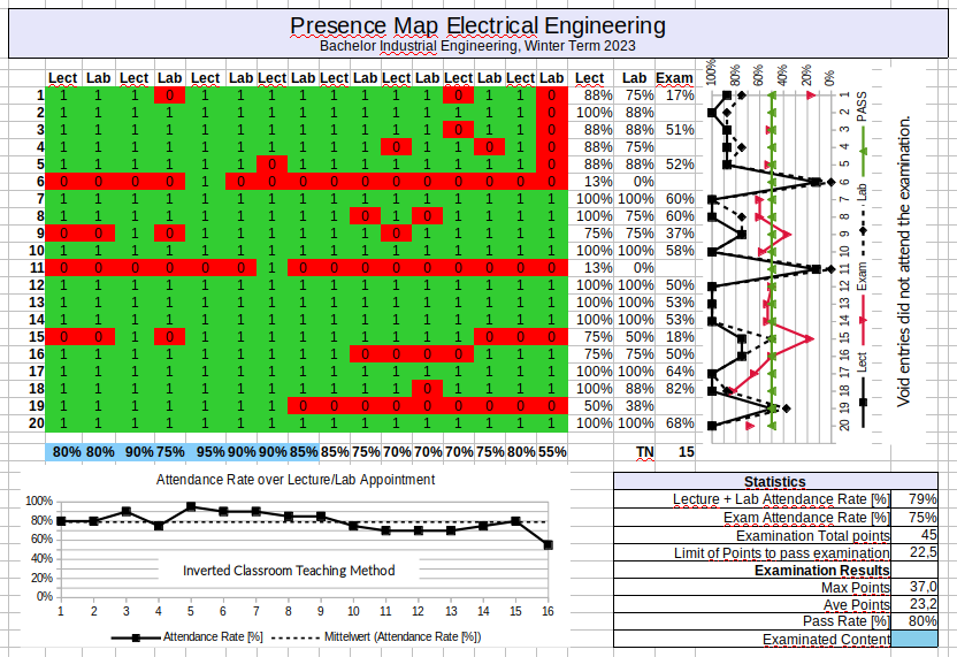 |
| Presence map with attendance and examination statistics. |
| Exam EIW (1st Semester) |
Enrolled |
Examined |
Attn Rate |
Passed |
Pass Rate |
| 1st attempt |
21 |
15 |
71% |
12 |
80% |
| 2nd attempt |
1 |
0 |
0% |
0 |
0% |
| 3rd attempt (or higher*) |
2 |
0 |
0% |
0 |
0% |
| Total |
24 |
15 |
63% |
12 |
80% |
*examination attempts for attestations without gradings are UNLIMITED as per examination regulations of the faculty Electrical Engineering
2.3 Electrical Engineering - Bachelor Industrial Engineering International (IWI))
| Bachelor Industrial Engineering International (IWI) |
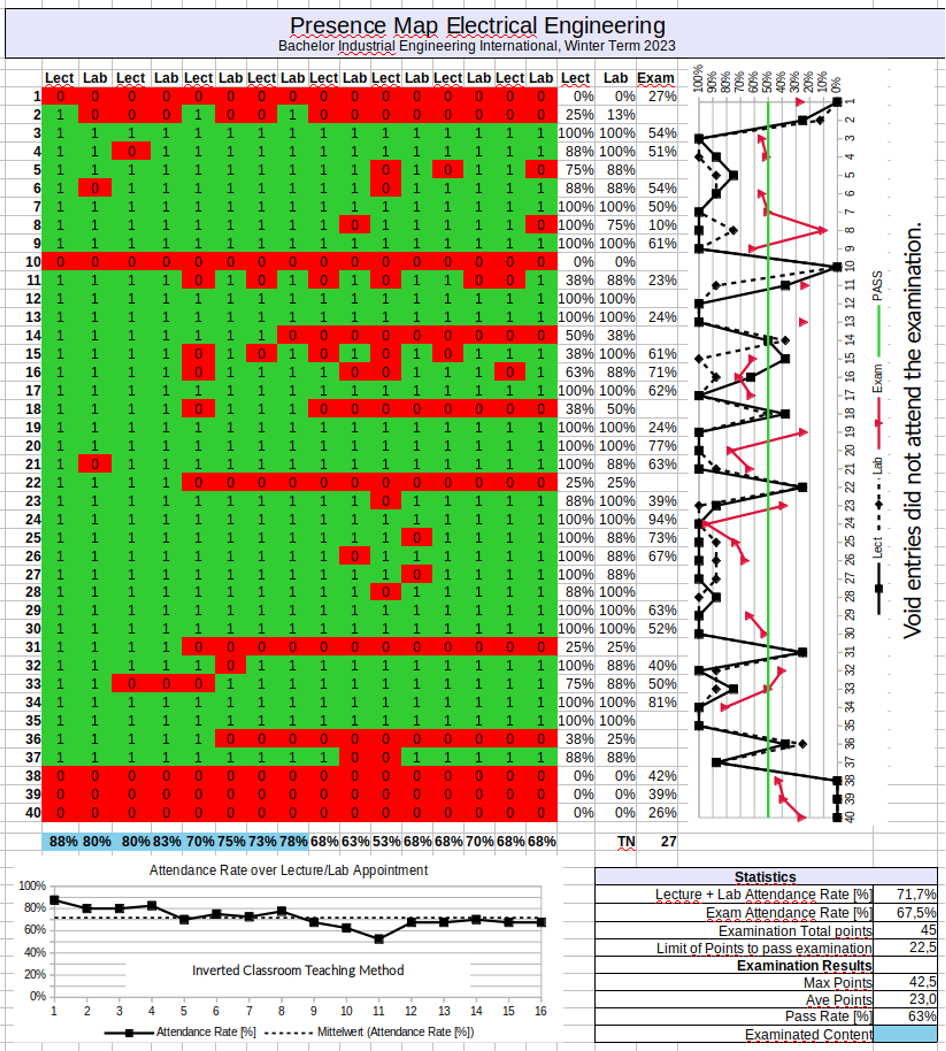 |
| Presence map with attendance and examination statistics. |
| Exam IWI (1st Semester) |
Enrolled |
Examined |
Attn Rate |
Passed |
Pass Rate |
| 1st attempt |
35 |
25 |
71% |
17 |
68% |
| 2nd attempt |
1 |
1 |
100% |
1 |
100% |
| 3rd attempt (or higher*) |
5 |
1 |
100% |
1 |
100% |
| Total |
41 |
27 |
66% |
18 |
66% |
*examination attempts for attestations without grading are UNLIMITED as per examination regulations of the faculty Electrical Engineering
 WS'23 - Print Savings due to Online-Examinations - 1760 Sheets.
Calculation: 10 sheets per examination (double-sided color prints for German and English versions) in average times registered attendees plus 10 prints for unregistered attendees. Unregistered attendees are allowed to attend the examination as per instruction of the examining board of the faculty. It will be decided later by the examination offices of the faculty, if the attendance was permitted.
Note: Students are registered for examinations by the University automatically and without self-action. The low attendance rates at examinations are the reason for lots of wasted prints. The University sticks to this practice despite several indications with the reasoning that students forget regularly to enroll for examinations. I therefore decided after the Corona pandemic to offer Online-Courses and Online-Examinations to eliminate this waste.
The waste savings due to prints for registered but non-attending students was 640 sheets of paper (i.e. 36,4%). This amount would have been printed and dumped. Students normally (some rare exceptions do exist) do not collect these prints for training purpose as far as I can confirm.